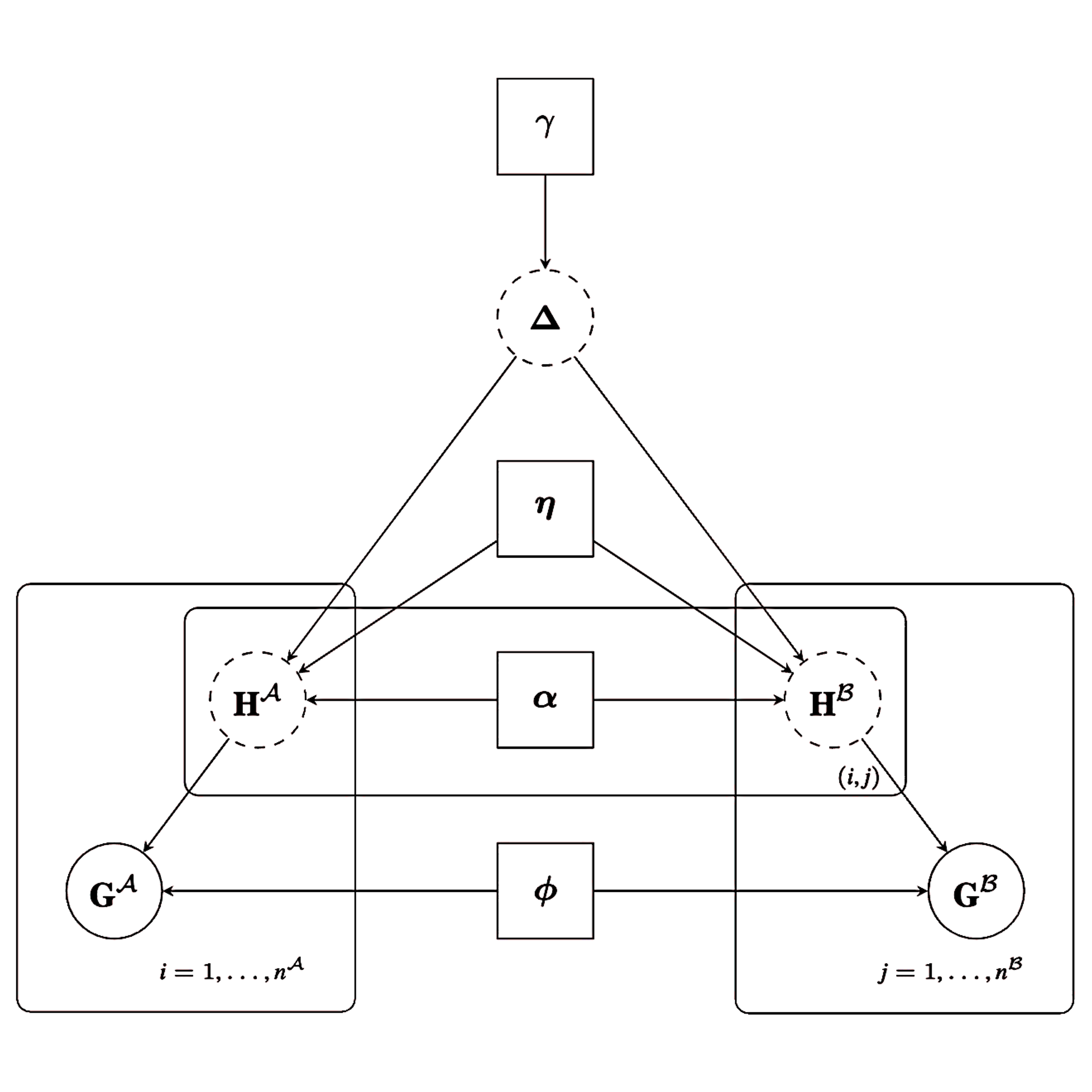
Simulate two linked data sources for record linkage benchmarking
Source:R/FlexRecordLinkage.r
simulate_data.RdCreates two synthetic data sources of given sizes sharing a given number
of common entities ("links"), each described by a set of Partially
Identifying Variables (PIVs). For every PIV, choose the number of
possible values, the proportion of mistakes and of missing values, and
whether it is stable over time, flexible (may change but change is not
modelled), or structured (expected to change over time, with a survival
model for the hazard of change). For structured PIVs, enforce_estimability
forces half of the linked pairs to have a near-zero time gap, which helps
separate "mistake" from "change over time" when fitting the model.
Usage
simulate_data(
  PIVs_config,
  n_values,
  n_records,
  n_links,
  p_mistake,
  p_missing,
  cond_hazard_params,
  enforce_estimability,
  model_dynamics = survival_model("exponential")
)
Arguments
- PIVs_config
Named list, one entry per PIV, each a list with:
dynamics("stable","flexible", or"structured"),bound_mistakes(length-2 numeric/NA, upper bound on the mistake probability in file 1 / file 2),fix_mistakes(length-2 numeric/NA, mistake probability fixed to this value in file 1 / file 2), and, only fordynamics = "structured",cond_hazard_cov(a list withcov1andcov2, the names of covariates in file 1 / file 2 used to model the hazard of change).- n_values
Integer vector, number of unique values per PIV (same order as
PIVs_config).- n_records
Integer vector of length 2, number of records to generate in file 1 and file 2 (file 2 must be the larger of the two).
- n_links
Integer, number of records shared between the two files.
- p_mistake
Named list (one entry per PIV) of length-2 numeric vectors, proportion of mistakes to introduce in file 1 / file 2.
- p_missing
Named list (one entry per PIV) of length-2 numeric vectors, proportion of missing values to introduce in file 1 / file 2.
- cond_hazard_params
Named list (one entry per PIV) of numeric vectors for the survival model generating the changes (see
survival_model()); only used fordynamics = "structured"PIVs.- enforce_estimability
Logical; if
TRUE, half of the linked pairs are given a near-zero time gap to help estimate the instability parameters.- model_dynamics
Object from
survival_model()used to generate the changes of the structured PIVs (default exponential).
Value
A list with: data1, data2 the two simulated (encoded)
data frames, n_values number of unique values per PIV, time_difference
time gap between linked records (NA if no PIV is structured),
proba_same_H matrix (n links x n PIVs) of probabilities that the true
values coincide, true_pairs data frame with the true 1/2 indices
of the linked records
Examples
PIVs_config <- list( V1 = list(dynamics = "stable",
                               bound_mistakes = c(0.10,0.10),
                               fix_mistakes = c(NA,NA)),
                     V2 = list(dynamics = "stable",
                               bound_mistakes = c(0.10,0.10),
                               fix_mistakes = c(NA,NA)),
                     V3 = list(dynamics = "flexible",
                               bound_mistakes = c(NA,NA),
                               fix_mistakes = c(NA,NA)),
                     V4 = list(dynamics = "structured",
                               bound_mistakes = c(NA,NA),
                               fix_mistakes = c(0.03,0.03),
                               cond_hazard_cov = list(cov1=c("Xe", "Xf"),
                                                    cov2=c())) )
n_values  <- c( 5, 6, 7, 12 )
p_mistake <- list( V1 = c(0.02, 0.02), V2 = c(0.02, 0.02),
                  V3 = c(0.05, 0.05), V4 = c(0.02, 0.02) )
p_missing <- list( V1 = c(0.005, 0.005), V2 = c(0.005, 0.005),
                  V3 = c(0.005, 0.005), V4 = c(0.005, 0.005) )
cond_hazard_params <- list( V1 = c(), V2 = c(),
                            V3 = c(), V4 = log(c(0.7, 0.6, 0.5)) )
gen_data <- simulate_data( PIVs_config, n_values, c(150, 200), 100,
                           p_mistake, p_missing, cond_hazard_params, TRUE )
str(gen_data, max.level = 1)
#> List of 6
#>  $ data1          :'data.frame':	150 obs. of  11 variables:
#>  $ data2          :'data.frame':	200 obs. of  9 variables:
#>  $ n_values       : int [1:4] 5 6 7 12
#>  $ time_difference: num [1:100] 0.004189 0.007668 0.000954 0.00834 0.000271 ...
#>  $ proba_same_H   : num [1:100, 1:4] 1 1 1 1 1 1 1 1 1 1 ...
#>  $ true_pairs     :'data.frame':	100 obs. of  2 variables: